

In an era when Indian women were just beginning to break into the sporting world, Leela Row Dayal emerged as a pioneer—not just on the tennis court, but in fields as diverse as classical dance, writing, and mountaineering. Best remembered as the first Indian woman to win a match at Wimbledon, Row’s extraordinary life is a tale of talent, versatility, and quiet determination.
Early Life and Education
Born in December 1911, Leela Row came from a distinguished family. Her father, Raghavendra Row, was a renowned physician, while her mother, Pandita Kshama Row, was among the foremost Sanskrit scholars of her time—and also one of India’s earliest women tennis champions. Educated at home under her mother’s guidance, Leela excelled in both academics and the arts.
A bout of malaria as a child led her mother to encourage physical activity. This not only restored Leela’s health but also introduced her to Indian classical dance at the age of three. Leela’s upbringing included exposure to the arts in Europe, where she studied violin in Paris and developed a passion for the stage.
The Tennis Journey: Following in Her Mother’s Footsteps
It was from her mother that Leela inherited a love for tennis. In the 1920s, Kshama Row had already made her mark by winning the 1927 Bombay Presidency Hard Court Championships. Inspired, Leela began competing, partnering with her mother in doubles and dominating national circuits as a singles player.

She won her first national title at the 1931 All India Championship, eventually amassing seven singles titles at this prestigious event. She also claimed the West of India Championships title that year and later, the Hampshire Tennis Championships in England in 1935.


Making History at Wimbledon
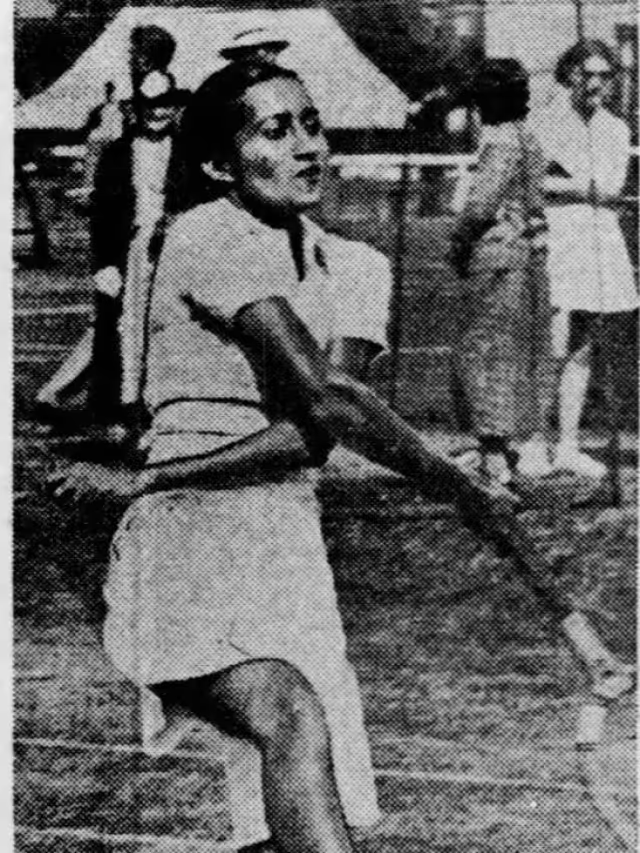
Leela Row etched her name in history at the 1934 Wimbledon Championships, where she became the first Indian woman to win a singles match at Wimbledon, defeating Britain’s Gladys Southwell in a dramatic 4-6, 10-8, 6-2 contest. Though she fell to France’s Ida Adamoff in the second round, her feat was groundbreaking.
She returned to Wimbledon in 1935 but lost in the opening round to Britain’s Evelyn Dearman. It would take 71 years before another Indian woman, Sania Mirza, competed in the senior ladies’ singles draw at the All England Club.
Leela also made strides at the French Open, reaching the second round in 1935 after several earlier attempts.
Beyond Tennis: A Life of Many Passions
Leela’s life extended far beyond the tennis court. In 1943, she married Harishwar Dayal, a distinguished civil servant and diplomat. When posted to the United States, she continued playing exhibition tennis matches but soon devoted herself to documenting Indian classical dance.
Though not a professional dancer herself, Leela authored important works in English and Sanskrit, including Natya Chandrika (archived by the US Library of Congress) and Nritta Manjari, both of which explored the intricate art of Indian dance and drama.

Mountains Called, and She Answered
Leela and her husband shared a passion for mountaineering. During his tenure as India’s ambassador to Nepal in the 1960s, she trekked extensively in the Himalayas. In the Khumbu region near Mount Everest, Leela became the first Indian woman to visit the Thyangboche Monastery.
She described trekking up the Taboche ridge as “the biggest thrill of my life” and felt that her “life’s dream had been fulfilled.” Sadly, during one of their mountain expeditions in 1964, her husband Harishwar Dayal passed away.
Legacy and Recognition
Despite her extraordinary contributions to Indian sport, arts, and mountaineering, Leela Row Dayal remains a relatively unsung hero. She was last mentioned in The Times of India in 1975, when a bird sanctuary in France showcased her paintings of Himalayan wildlife.

Her Wimbledon triumph was revisited in popular culture when it featured as a Rs 1 crore question on Kaun Banega Crorepati, hosted by Amitabh Bachchan. Contestant was asked who Leela defeated at Wimbledon—the answer: Gladys Southwell.
A True Inspiration
Standing at just 4 feet 10 inches, Leela Row Dayal was a giant in spirit. She blazed trails not just in tennis, but also in promoting Indian culture and embracing adventure. It’s time Indian sporting history remembers and celebrates this remarkable woman.

A beautiful digital illustration by Nitika Deshpande for BBC Telegu
Credit : The Hindu, ABP News, India Today, ScoopWhoop, Himalayan Journal, Govindraj Venkatachalam, My Contemporaries (1966) & Sony Liv